 RecipeTailor
Work out the factor first
Divide the amount you want to make by the amount the recipe makes. Half a batch is a factor of ½, so 3 eggs becomes 1½ and ¾ cup becomes ⅜ cup. Multiply every measured ingredient by the same number and keep each unit with its amount.
Check what the yield counts. Twelve cookies, twelve pancakes and twelve servings are not the same amount of food.
Measure half an egg
Crack the egg into a small bowl and beat it until the yolk and white are fully mixed. Weigh it, then use half that weight. For 1½ eggs, use one whole egg plus half of a second beaten one. Weighing works better than guessing because eggs vary in size.
If the recipe uses yolks and whites separately, keep them separate and halve each part. King Arthur Baking’s guide to reducing recipes covers dividing eggs this way.
Or choose a batch that uses whole eggs
If you’d rather not split an egg, change the batch size instead. With a 3-egg recipe, 1 egg makes ⅓ of the batch and 2 eggs make ⅔. Scale every other ingredient by the factor you picked.
For example, RecipeTailor’s Buttermilk Pancakes recipe makes 16 pancakes with 2 eggs. Twelve pancakes would need 1½ eggs. The nearest whole-egg batch is 8 pancakes with 1 egg, or the full 16.
| Pancakes | 16 | 12 | 8 |
|---|---|---|---|
| Factor | 1× | ¾× | ½× |
| Flour | 2 cups | 1½ cups | 1 cup |
| Buttermilk | 2 cups | 1½ cups | 1 cup |
| Eggs | 2 | 1½ | 1 |
| Butter | 4 tbsp | 3 tbsp | 2 tbsp |
Write the new amounts down before you start
Scaling in your head halfway through a recipe is where mistakes happen. Write every new amount down first. Keep odd fractions like ⅜ cup as they are until you decide how to measure them, and use a scale if the recipe gives weights. Converting cups to grams depends on the ingredient, so there’s no single number for a cup.
Leave “salt to taste” as it is. Watch for an ingredient that appears in two places, such as sugar in both the batter and the topping.
Check the pan and the baking time
Halving the ingredients doesn’t halve the baking time. A smaller cake or loaf needs a smaller pan, and you should go by the recipe’s doneness cues rather than the clock. King Arthur’s guide explains how to choose the pan for a reduced recipe.
Sources and further reading
Scale exactly with RecipeTailor
Save the recipe, tap Tailor recipe and set the yield you want. RecipeTailor scales every ingredient by the same exact factor. When an ingredient only comes whole, like eggs, it offers the nearest smaller and larger batches that keep the proportions, and you can cook from the one you pick. Your original recipe stays unchanged. Scaling saved recipes is free.
Free recipe scaling · iPhone and Android
See how RecipeTailor works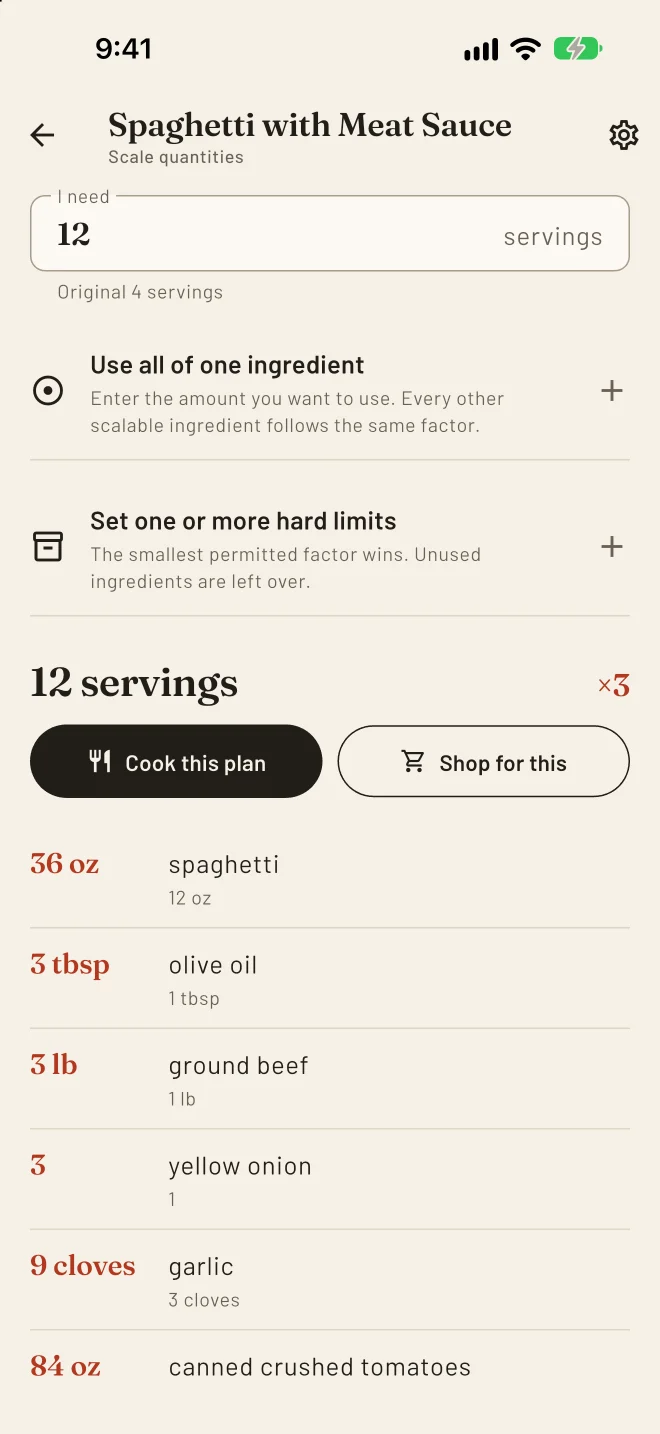
Questions
Can I just round 1½ eggs up to 2?
That makes the recipe eggier than written. To keep the proportions, measure the half egg, or scale up to a batch where the other ingredients rise along with the eggs.
Does RecipeTailor change the oven temperature and time?
No. It keeps the original directions, temperatures and times and changes the ingredient amounts. Check the pan and doneness cues yourself for the batch you make.